StreamHub
In beta — try it free

Your self-hosted media server WebRTC + RTMP + HLS + recording, all self-hosted

StreamHub is a management layer on top of LiveKit: sub-second WebRTC, multi-protocol ingest, live HLS, recording to your own S3, and a lightweight drop-in JavaScript SDK to publish and subscribe over WebRTC. Multi-tenant, with signed webhooks and observability.

The open-source (AGPL) alternative to Ant Media Enterprise — 0.19s p50 WebRTC measured in production, signed webhooks and a drop-in SDK to migrate without a rewrite. See the head-to-head →

  • WebRTC
  • RTMP
  • WHIP
  • RTSP
  • HLS
curl -fsSL https://www.streamhub.studio/install.sh | sudo bash

One-liner install · Ubuntu 24.04 / 26.04 LTS · what it provisions →

Open source · self-hostable …or we host it for you
app.streamhub.studio
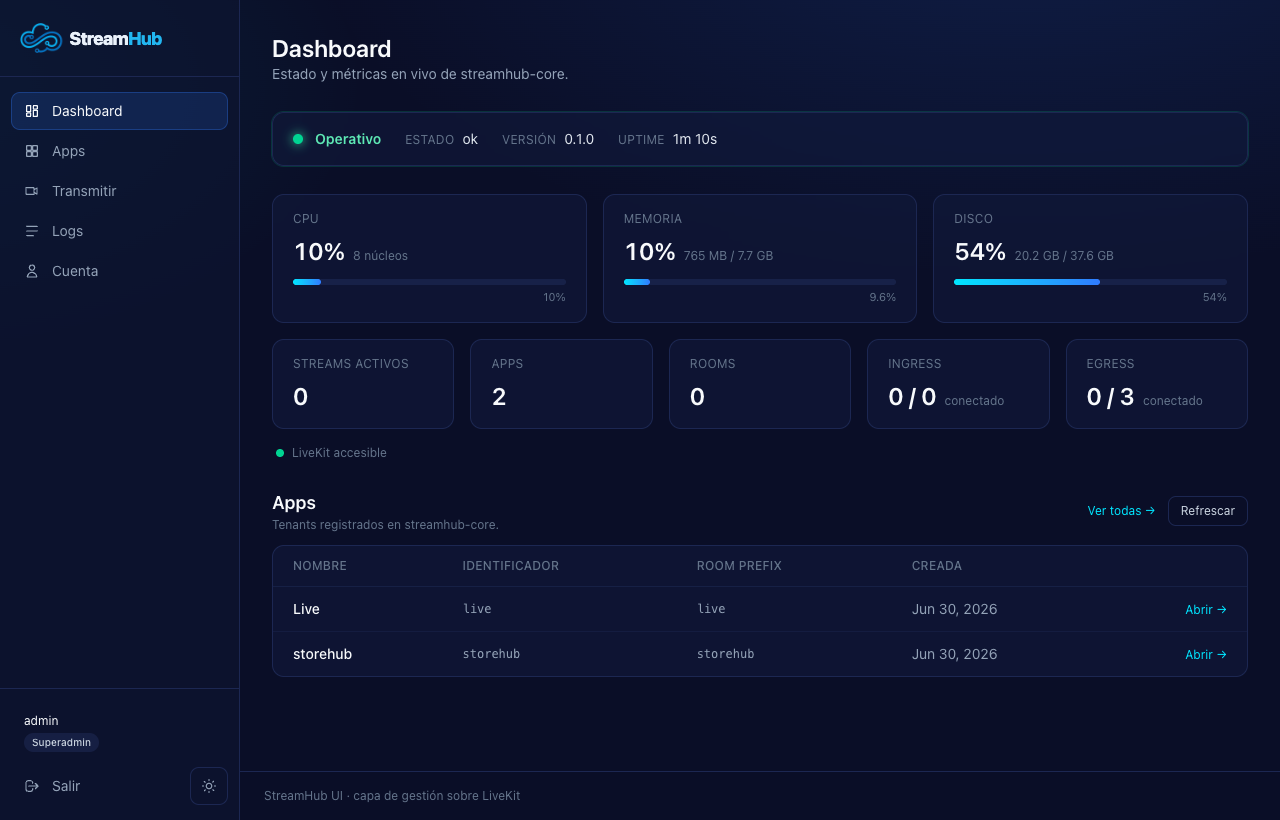
StreamHub dashboard: server status, CPU/memory/disk, active streams, apps and ingress/egress live
StreamHub vs Ant Media Enterprise

Everything you run Ant Media EE for, open source and self-hosted

StreamHub covers the Ant Media Server Enterprise feature set for real-world streaming — measured, not promised — and adds the pieces we always missed: signed webhooks, per-app tenancy and a plugin marketplace. AGPL-licensed, free while in beta, and your media never leaves your infra.

0.19s

WebRTC latency — p50 measured over 601 samples in production

$0

license cost — open source (AGPL). Ant Media EE: ~$109/mo per instance

1 line

to install — curl | sudo bash on Ubuntu 24.04 / 26.04 LTS

License & price

StreamHub · Open source (AGPL). No per-instance license — free while in beta.

Ant Media EE · Proprietary. ~$109/mo (~$1,068/yr) per instance.

WebRTC latency

StreamHub · 0.19s p50, measured end-to-end over 601 samples in production.

Ant Media EE · ~0.5s per its marketing. Both are genuinely sub-second.

Webhooks

StreamHub · Every event is POSTed with an HMAC-SHA256 signature you verify in your backend.

Ant Media EE · Webhooks without a signature — you trust whoever calls.

Recording → S3

StreamHub · MP4 to your own bucket per app + periodic snapshots, indexed VODs with pagination and presigned download.

Ant Media EE · Records MP4/WebM to S3 as well — parity here.

Multi-tenant

StreamHub · Each app is a real tenant: isolated rooms, S3, database, tokens, quotas, teams and roles.

Ant Media EE · Applications scope settings and streams.

Migration SDK

StreamHub · @streamhub/adaptor shims Ant Media's WebRTCAdaptor: same callbacks and methods, no rewrite.

Ant Media EE · Its own WebRTCAdaptor SDK.

Plugins

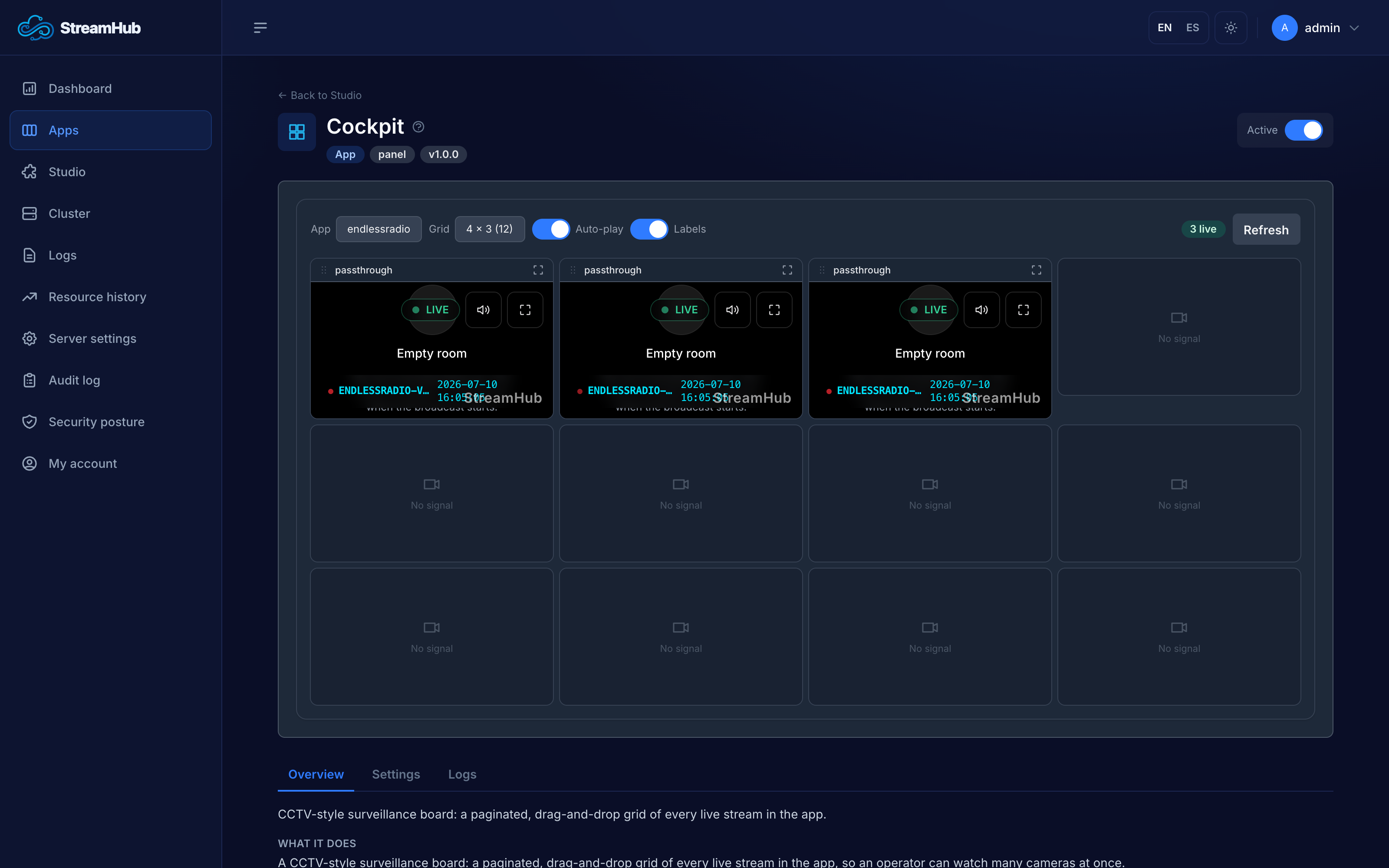
StreamHub · Marketplace with working verticals: YOLO detection, CCTV cockpit, radio, watermark, live chat.

Ant Media EE · Java plugin SDK — you build your own.

Cluster & install

StreamHub · Origin + edge; an edge joins with one command and a token. Idempotent one-liner installer, TLS included.

Ant Media EE · Origin + edge cluster (EE feature); script install plus license setup.

Observability

StreamHub · Native Prometheus /metrics + Grafana, and logs with 30-day retention right in the panel.

Ant Media EE · Kafka-based monitoring pipeline into Grafana.

No smoke

Ant Media EE is a mature product and still ahead on config granularity (~170 per-app settings), native mobile SDKs and multi-destination restreaming — that last one sits at the top of our roadmap. If those are your blockers today, we'd rather tell you now.

Coming from Ant Media?

Swap the SDK import — your callbacks keep working.

Features

A complete media server, self-hosted

WebRTC, RTMP, WHIP, RTSP and HLS; recording to your S3; realtime, multi-tenant, signed webhooks and a lightweight WebRTC SDK. Built on LiveKit, self-hosted.

Streaming

Multi-protocol ingest and output

Come in however you want, go out in low-latency WebRTC or embeddable HLS.

Low-latency WebRTC

sub-second

WebRTC player on LiveKit with sub-second latency for "watch live now" and video calls. Ephemeral per-room subscribe tokens.

RTMP ingest

RTMP · OBS

Push from OBS/ffmpeg to rtmp://…:1935/live/<key>. Stream key + optional password: StreamHub drops any push that wasn't validated first.

WHIP

WebRTC-HTTP

WHIP endpoint to publish over WebRTC straight from the browser or modern encoders, without going through RTMP.

RTSP relay

RTSP pull

Pull from a remote source (rtsp://camera/stream) and republish it into the room. Ideal for IP cameras and NVRs.

Live HLS

video.js

Segmented HLS egress served at /hls/<app>/<room>/index.m3u8 (video.js, open CORS). ~6-15s, embeddable anywhere.

Recording & output

Record to your own S3, restream anywhere

The media is yours: it lands in your bucket. Outputs go to YouTube, Twitch or your CDN.

Recording to YOUR S3

AWS · Wasabi · MinIO

MP4 egress uploaded to your own S3 bucket (AWS, Wasabi, MinIO). One bucket/prefix per app; keys never live in the YAML.

Ready-to-play VOD

VOD

Every recording lands as a VOD in your S3 with a snapshot, metadata (duration/resolution/codec) and a public or presigned URL.

Split MP4 by parts

split N min

Cut the recording every N minutes: each part is its own MP4 = its own VOD, indexed and with a recording_part_ready callback.

Periodic snapshots

JPEG every Ns

Capture a JPEG every N seconds during recording, uploaded to your S3. On-demand snapshots of any room too.

Webcam broadcast → RTMP

YouTube · Twitch

Forward a room to an external RTMP/RTMPS (YouTube/Twitch/custom) with the Broadcast widget: browser webcam → restream.

Realtime

Live interaction and events

Chat, reactions and viewers over data-channels; signed webhooks for everything that happens.

Live chat

data-channel

Chat over LiveKit data-channels (with emojis). The backend can inject messages and it fires the chat_message callback.

Reactions

reactions

Floating animated reactions on the reaction topic: real-time hearts and likes, with their reaction callback.

Viewer counter

live

Real subscriber count per live stream, excluding publishers and hidden/QC participants. Exported to Prometheus.

Signed webhooks

HMAC-SHA256

StreamHub posts a signed JSON (HMAC-SHA256) for EVERY event: room, participants, ingress/egress, recording, VOD and HLS.

Embeddable players

/play · /embed

Public /play and /embed pages + iframe snippet. WebRTC and HLS players without auth, with a chat/reactions/viewers panel included.

Scale

Multi-tenant, adaptive and observable

Isolated apps, adaptive transcoding with optional GPU and Prometheus metrics for everything.

Adaptive transcoding

720 / 480 / 240

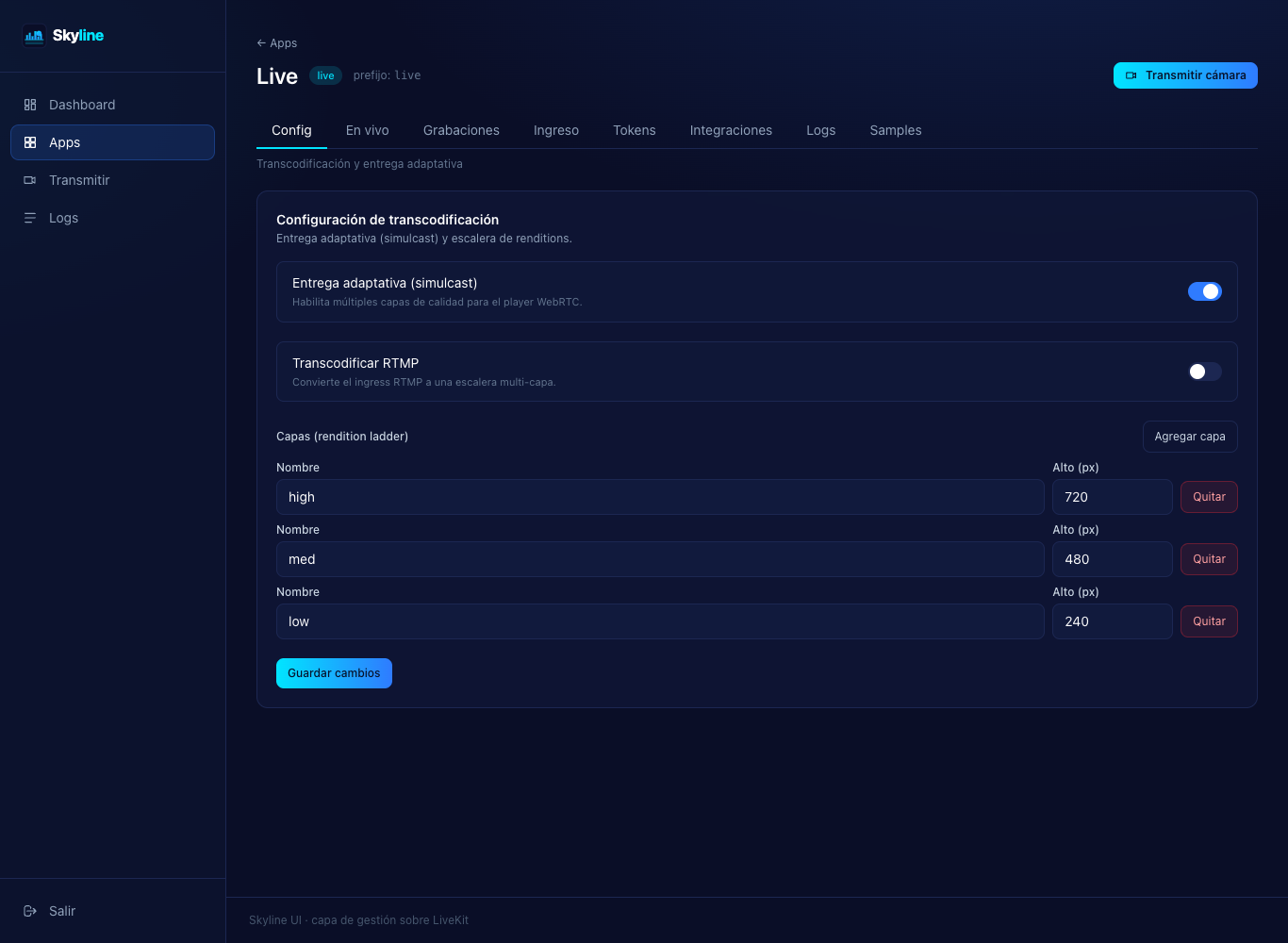
Rendition ladder via LiveKit simulcast + multi-layer ingress for an adaptive player per app, with no extra config.

Optional GPU

NVENC · VAAPI

Per-node GPU detection (NVIDIA nvidia-smi / VAAPI /dev/dri) and auto/gpu/cpu hwaccel per app. Never fails when there's no GPU.

Isolated multi-tenant apps

apps

Each app is a tenant: namespaced rooms/streams, its own S3, its own VODs/DB, its own tokens and callbacks — fully isolated.

Teams, roles and quotas

RBAC · quotas

Teams isolated per tenant, roles/permissions and quotas: apps, concurrent streams, recording minutes and GB of egress per month.

Observability

Prometheus

Prometheus metrics at /metrics (streams, viewers, VODs, S3 uploads, callbacks, GPU…), health probe, stats and queryable logs.

Per-app SQLite

SQLite

Global streamhub.db registry + one vods.db per app. No heavy database to operate: SQLite per tenant and media in S3 per app.

Operations

A backoffice that runs the whole fleet

Everything you used to SSH for, now in the panel: per-app dashboards, logs, VODs, cluster, server settings and backups.

Per-app dashboard

stats · filters

Each app gets its own board: active streams, live viewers, ingress/egress and recording activity, filterable per tenant.

Log management

30-day retention

Global and per-app logs with 30-day rotation, queryable and paginated from both the API and the panel. No SSH needed.

VOD library + download

paginated · presigned

Paginated VOD listing per app with snapshots and metadata, plus one-click download via presigned S3 URLs.

Cluster manager

origin + edge

Every node with its stats and health, right in the dashboard. An edge joins the cluster with a token and one command.

Server settings panel

no YAML edits

Server-wide configuration from the backoffice, Ant Media style: tune the server without touching files over SSH.

Backups + runbook

restore · rollback

Automated backups of the SQLite databases and per-app config, with a documented restore and rollback path.

Devs

API, drop-in SDK and open source

Everything over an API, everything self-hostable. Drop in the SDK and start publishing in a few lines.

Drop-in JS SDK

@streamhub/adaptor

A lightweight JavaScript SDK: pull in @streamhub/adaptor (npm or a <script> tag) and StreamHubAdaptor lets you publish and subscribe over WebRTC in a few lines.

REST API

/api/v1

API under /api/v1 with an { data, error } envelope. Apps, ingress, recording, VODs, tokens, broadcast and HLS: all over HTTP.

Auth + API tokens

JWT · sk_ tokens

Built-in auth (JWT signup/login, teams, superadmin) + sk_ API tokens for server-to-server. Bearer on every endpoint.

Radio / audio-only

audio-only

Audio-only rooms (Discord-style voice) + radio mode: one host publishes and listeners join hidden, subscribe-only, with a public listen-token.

Open source or hosted

self-host · hosted

Self-hostable end to end (Docker + LiveKit). In beta and free. Don't want to run it? We host it for you.

Use cases

One server, four verticals ready to go

The same building blocks — multi-protocol ingest, sub-second WebRTC, recording to your S3, plugins — combined into setups already running on StreamHub.

CCTV / video surveillance

RTSP · YOLO · S3

Plug IP cameras and NVRs in over RTSP and watch everything from a multi-camera cockpit.

  • RTSP relay into WebRTC rooms — sub-second, not 6s of HLS
  • YOLO plugin: object detection over the live stream
  • CCTV cockpit from the marketplace: multi-camera wall
  • 24/7 recording split into N-minute MP4 parts in your S3

Live shopping

WebRTC · chat · embed

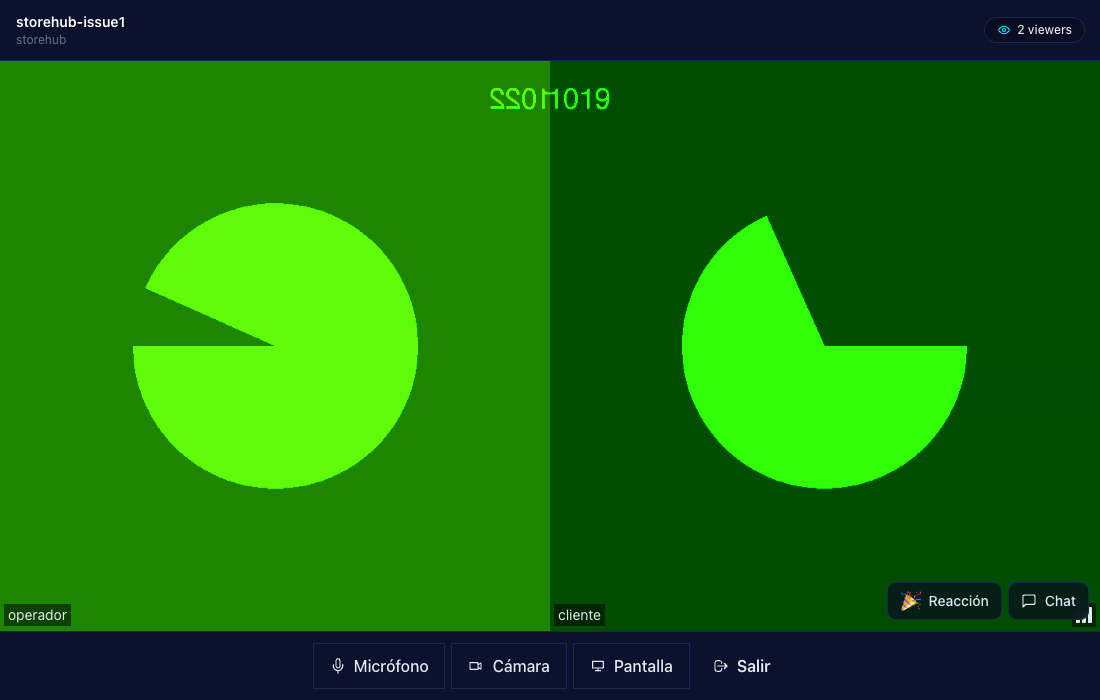
Sell live at conversation latency, with interaction built in and embedded right in your store.

  • 0.19s WebRTC player: the "buy now" lands on time
  • Chat, reactions and a live viewer count included
  • Public /embed iframe for your e-commerce
  • Signed webhooks drive your backend (stream_started, vod_ready)

Telemedicine

1:1 · self-hosted

Video consultations on your own infrastructure: patient data never leaves your S3.

  • Private 1:1 rooms with mic, camera and screen share
  • Ephemeral per-room tokens: nobody joins without one
  • Self-hosted = real data sovereignty (your infra, your S3)
  • Consent-based recording to your bucket, VOD ready

Online radio

audio-only · listen-token

Stations and voice rooms without video: one host publishes, listeners tune in with a public link.

  • Audio-only rooms, Discord-style
  • Radio mode: hidden, subscribe-only listeners
  • Public listen-token to embed the player anywhere
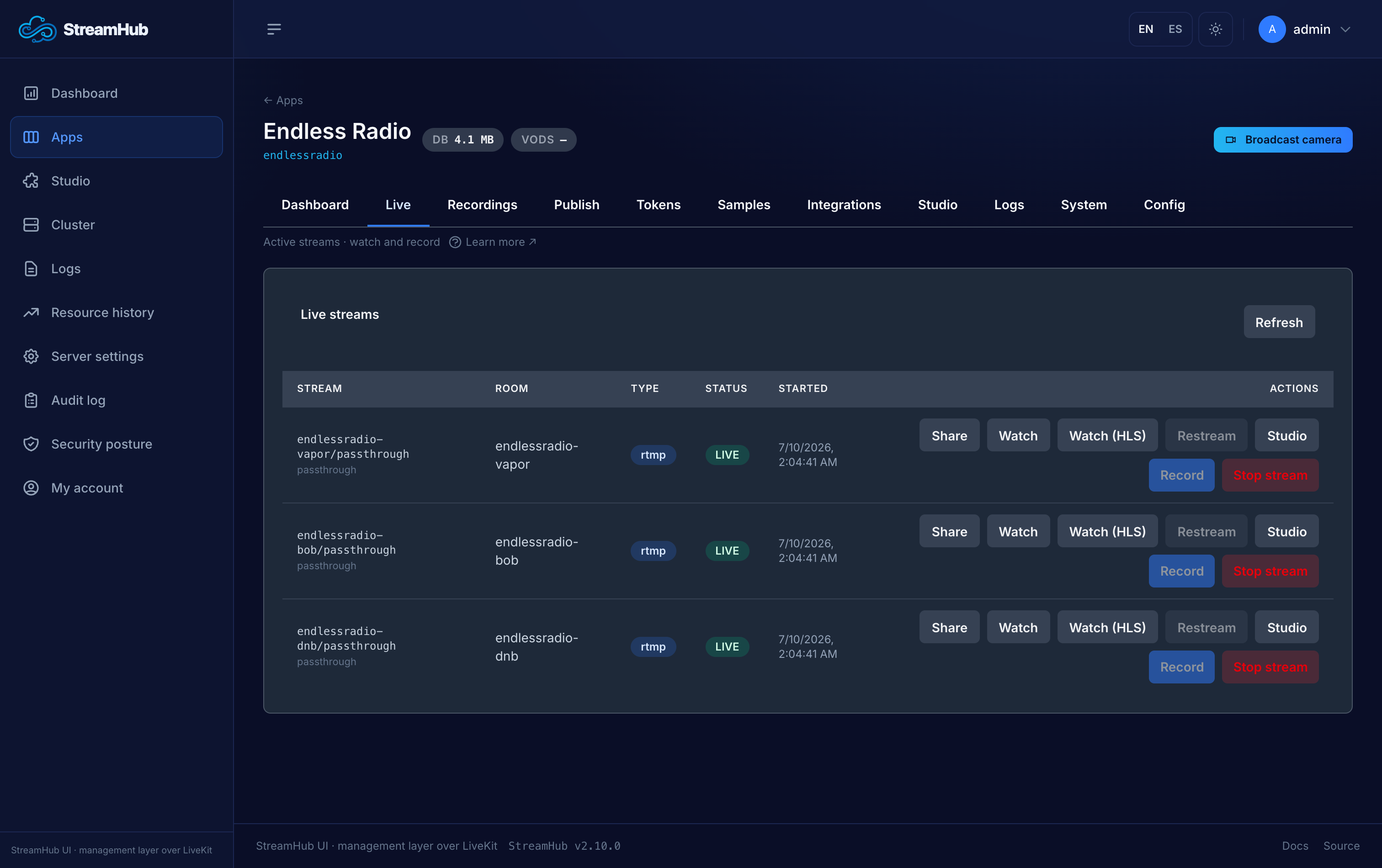
  • Radio plugin from the marketplace
Take a look

Your backoffice, live

Real screenshots of the StreamHub backoffice. One place for your apps, streams, recordings, tokens and webhooks — running on LiveKit.
app.streamhub.studio live
Real-time dashboardSub-second live playerMulti-participant roomsMulti-protocol ingestAdaptive delivery per appIsolated, multi-tenant apps

Real-time dashboard

Core status at a glance: live CPU, memory and disk, active streams, registered apps and ingress/egress connections. Plus per-app boards, a cluster view and 30-day logs — no SSH needed.

Live metricsPer-app boardsCluster + logs
See it in the app

Light or dark, your call — the whole backoffice is themed.
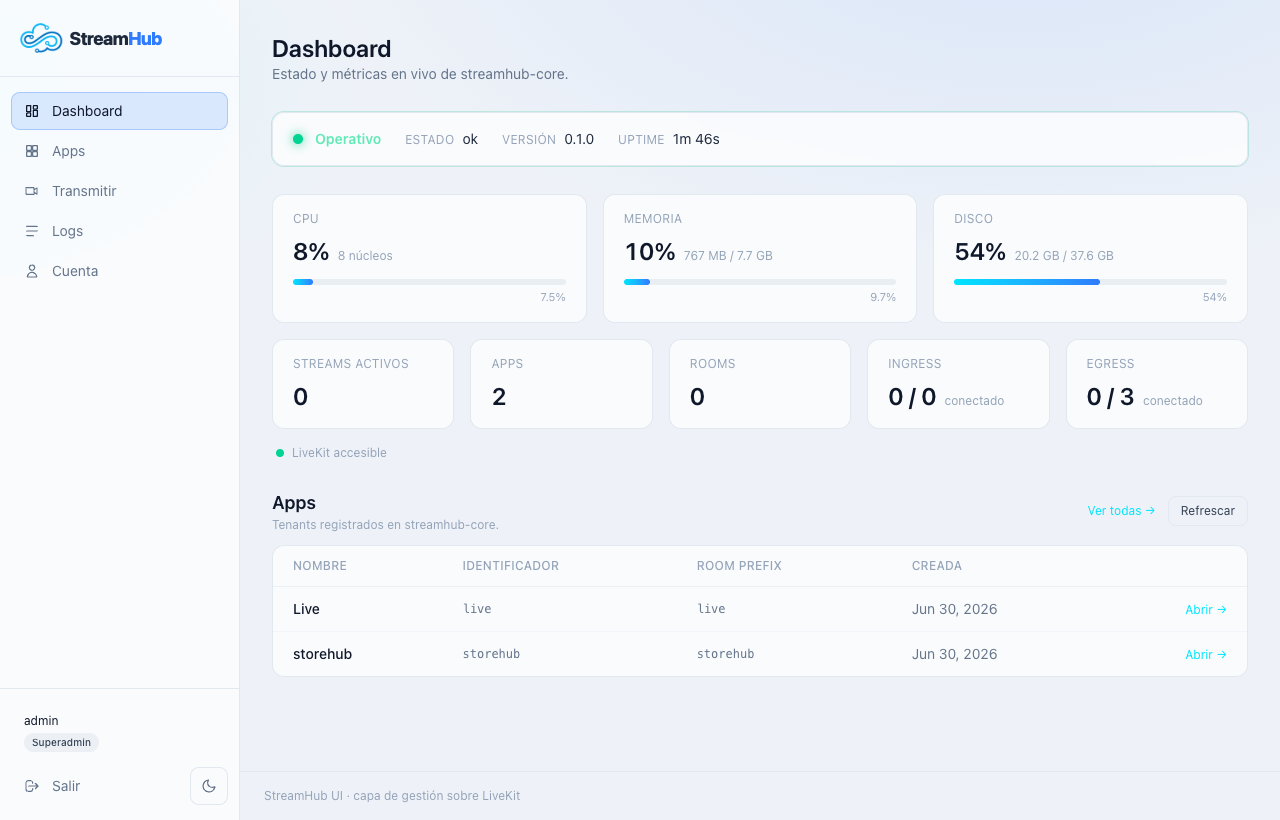
Dashboard · light theme
Built-in auth · login

How it works

From zero to on-air in three steps.

01

Create an app

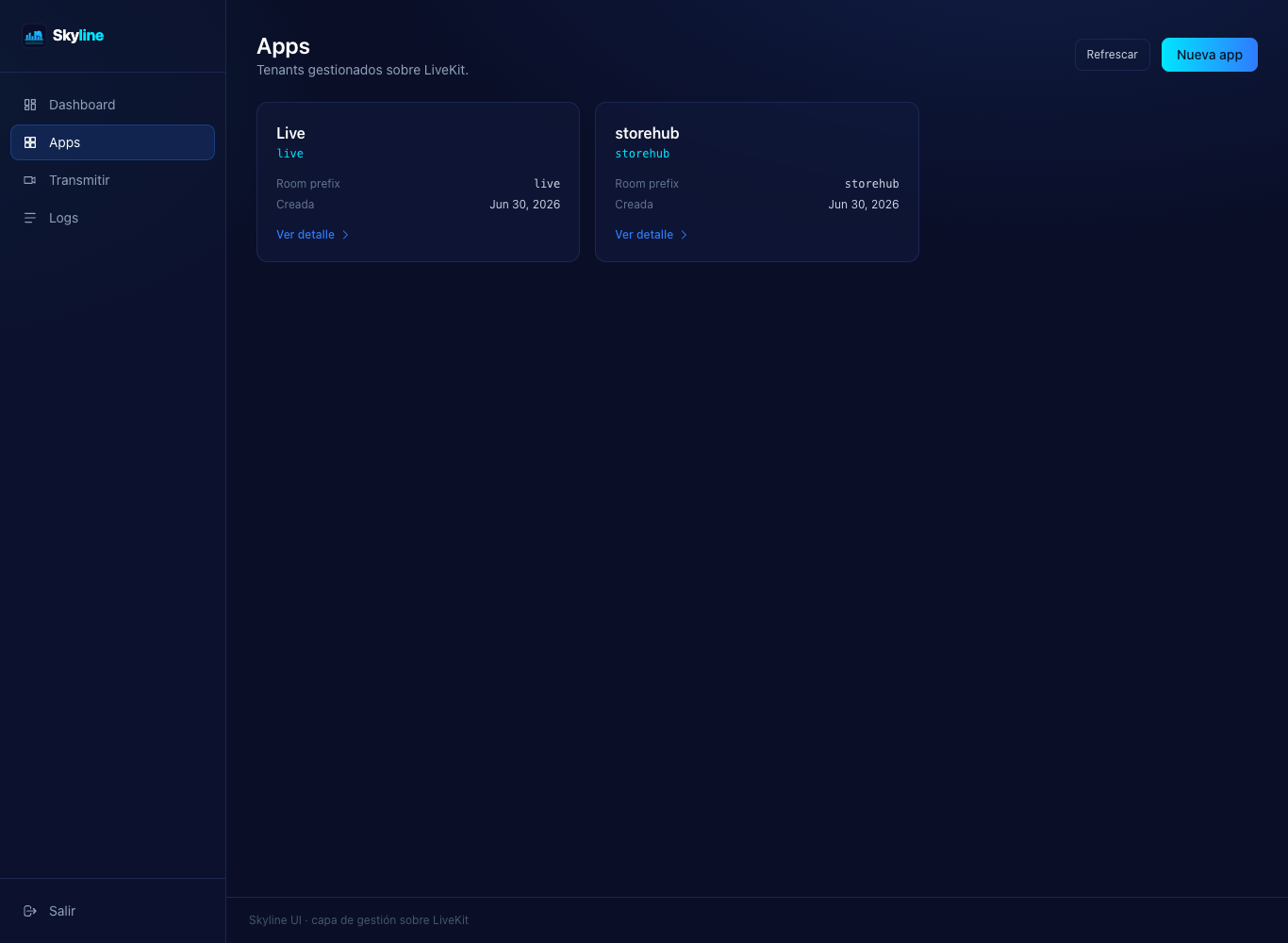
Each app is an isolated tenant: its own room prefix, S3 bucket, tokens and quotas. Ready in seconds from the backoffice.

02

Publish

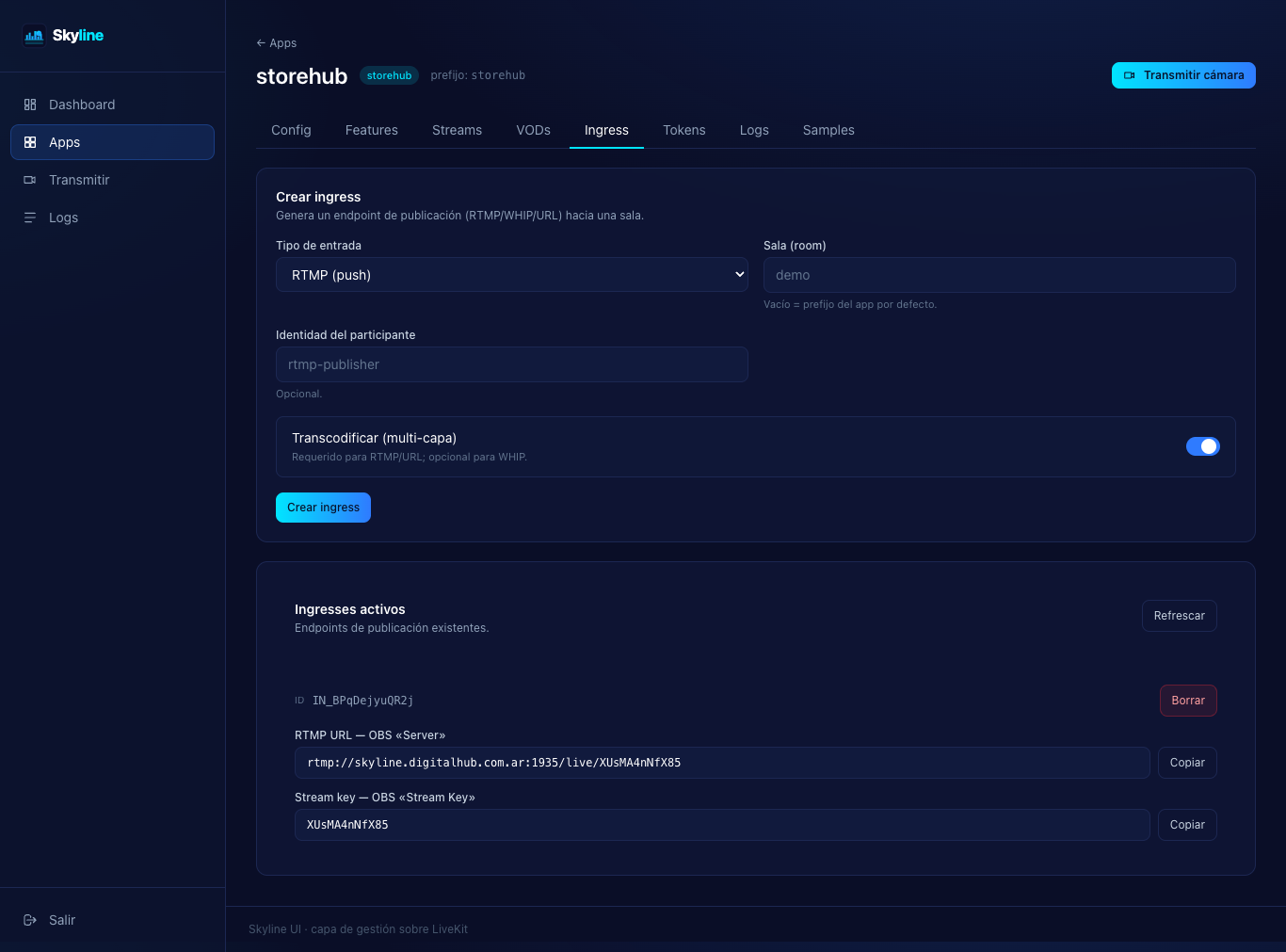
Push your feed over RTMP, WHIP, RTSP or straight from the webcam. Copy the URL and stream key into OBS and go live.

03

Watch, record and embed

Sub-second WebRTC or HLS, recording to your own S3 (VOD + snapshots) and embeddable players via public link or iframe.

Try it with your own streams

We're in beta and it's free. Open source and self-hostable — or we host it for you.

Documentation

Docs & API

A complete, self-hostable stack — documented end to end. A REST API (global and per-app), signed webhooks, per-app config, native integrations and a one-command deploy. Every route lives behind a single domain, with a live OpenAPI explorer.

Features

Per-feature deep-dives, from WebRTC to quotas.

  • WebRTC · ingest · HLS-live
  • Recording → S3 · VOD
  • Broadcast · transcoding/GPU
  • Chat · reactions · viewers

Global API

Server-wide REST surface, guarded by sk_ tokens.

  • GET /health · /stats
  • CRUD /apps
  • POST /tokens (mint sk_)
  • GET /logs
Open in Swagger →

Per-app API

Everything scoped to a single tenant app.

  • tokens · ingress · recording
  • vods · streams · snapshots
  • HLS start/stop
  • config · transcoding layers
Open in Swagger →

Webhooks & callbacks

Incoming LiveKit events and outbound signed POSTs.

  • HMAC-SHA256 signature
  • stream_started / _ended
  • vod_ready · recording_failed
  • chat_message · reaction

Config reference

The per-app config.yaml, secrets stripped.

  • recording · rtmp · webrtc
  • per-app S3 bucket
  • features block
  • callbacks url + secret

Integrations

Native and device clients, and the protocol each speaks.

  • Android (livekit-android)
  • iOS (LiveKitClient)
  • C++ (ffmpeg → RTMP)
  • ESP32-CAM → relay → RTMP

Self-hosting

One curl | sudo bash — or docker compose up.

  • one-liner installer (Ubuntu LTS)
  • join-cluster with a token
  • runbook · backups · rollback
  • Prometheus + Grafana

Architecture

How it is built and where it is heading.

  • mono-Node core + LiveKit
  • per-app SQLite data model
  • origin + edge cluster
  • WebRTC vs HLS/CDN

The REST API in five calls

Authenticate with a sk_ token. Room names are namespaced under the app prefix (live + demolive-demo).

base ·https://streamhub.digitalhub.com.ar/api/v1
# Scaffold an isolated tenant: config, per-app SQLite, S3 prefix, samples
curl -s -X POST https://streamhub.digitalhub.com.ar/api/v1/apps \
  -H "Authorization: Bearer $STREAMHUB_TOKEN" \
  -H "Content-Type: application/json" \
  -d '{"name":"live","displayName":"Live","roomPrefix":"live"}'
Signed webhooks HMAC-SHA256
// Every callback is a signed POST. Verify the HMAC-SHA256 over the raw body.
import crypto from 'node:crypto';

app.post('/streamhub', express.raw({ type: 'application/json' }), (req, res) => {
  const sig = req.header('X-StreamHub-Signature');                 // "sha256=<hex>"
  const expected =
    'sha256=' + crypto.createHmac('sha256', SECRET).update(req.body).digest('hex');
  if (!sig || !crypto.timingSafeEqual(Buffer.from(sig), Buffer.from(expected)))
    return res.status(401).end();

  const evt = JSON.parse(req.body.toString('utf8'));              // { event, app, data }
  switch (evt.event) {
    case 'stream_started':   /* a publisher/ingress went live */  break;
    case 'vod_ready':        /* recording uploaded to your S3 */  break;
    case 'recording_failed': /* upload failed, local file kept */ break;
  }
  res.status(200).end();
});
Self-host in one command curl | sudo bash
# Open source — one command provisions a full node (Ubuntu 24.04/26.04 LTS):
curl -fsSL https://www.streamhub.studio/install.sh | sudo bash
# docker + LiveKit + ingress/egress + core + nginx/TLS + seeded API token. Idempotent.

# Prefer to wire the pieces yourself? (non-interactive install)
curl -fsSL https://www.streamhub.studio/install.sh | sudo bash -s --   --non-interactive --domain media.example.com --email you@example.com
# then edit /opt/streamhub/.env  (LiveKit keys, per-app S3, PUBLIC_BASE_URL)

# Swagger / OpenAPI:  /api/v1/docs      Metrics:  /metrics      Health:  /api/v1/health

This is a tour, not the whole map — the full reference covers architecture, operations, testing and every environment variable. Explore it live in the OpenAPI docs, or read the streamhub-docs in the repo.

streamhub-adaptor

A lightweight WebRTC SDK — publish and subscribe in a few lines

@streamhub/adaptor is a lightweight JavaScript SDK for publishing and subscribing over WebRTC, built on livekit-client. It speaks the same language as Ant Media's WebRTCAdaptor — same string callbacks, same methods — so an existing Ant Media front-end migrates by swapping the import, not rewriting it.

migrating from Ant Media: swap one import
- import { WebRTCAdaptor } from "@antmedia/webrtc_adaptor";
+ import { StreamHubAdaptor } from "@streamhub/adaptor";

// Same callbacks, same methods — your Ant Media front-end keeps working.
const adaptor = new StreamHubAdaptor({ /* config below */ });
Install npm
npm install @streamhub/adaptor livekit-client
import { StreamHubAdaptor } from "@streamhub/adaptor";

const adaptor = new StreamHubAdaptor({
  // StreamHub mints the LiveKit token for you (prefer a pre-minted token + wsUrl in prod)
  streamhubApiUrl:   "https://streamhub.digitalhub.com.ar/api/v1",
  appName:           "live",
  streamhubApiToken: STREAMHUB_TOKEN,        // dev only — mint server-side for production
  mediaConstraints:  { video: true, audio: true },
  localVideoId:      "localVideo",           // <video id="localVideo"> preview element
  callback: (info, obj) => {
    if (info === "initialized")        adaptor.joinRoom("demo", "camera-1");
    else if (info === "joinedTheRoom") adaptor.publish(obj.streamId);   // send cam + mic
    else if (info === "publish_started") console.log("on air");
  },
  callbackError: (err, msg) => console.warn(err, msg),
});
No build step? Drop in one tag IIFE · CDN
<!-- No build step? Drop in one script tag and you're ready. -->
<script src="https://streamhub.digitalhub.com.ar/sdk/streamhub-adaptor.global.js"></script>
<script>
  const viewer = new StreamHubAdaptor({ isPlayMode: true, /* ...config */ });
</script>
Embeddable player <iframe>
<!-- The mint call returns a ready-to-paste embed. Public player, no SDK needed. -->
<iframe
  src="https://streamhub.digitalhub.com.ar/embed/live/live-demo"
  width="640" height="360" frameborder="0"
  allow="autoplay; fullscreen; camera; microphone"
  allowfullscreen>
</iframe>

Drop-in for Ant Media's WebRTCAdaptor

same callbacks — initialized, publish_started, newStreamAvailable, data_received… — swap the import, keep your code

Methods

joinRoom, publish, play, sendData, switchVideoCameraCapture, enableStats…

Device & bitrate control

swap camera or mic on the fly and tune bitrate per sender, live

Data channels

chat and reactions ride LiveKit DataPackets; canPublishData is granted on every token

LiveKit handles simulcast and adaptive streaming natively. For production, mint tokens server-side and pass token + wsUrl so the management token never reaches the browser.

Install

From a bare Ubuntu box to on-air in one command

The hosted installer provisions the whole stack on a clean Ubuntu Server: Docker, LiveKit, ingress/egress, the StreamHub core, nginx with TLS certificates and a seeded API token. Idempotent — re-running upgrades in place and never rotates your secrets.

Install an origin node — day 0
$ curl -fsSL https://www.streamhub.studio/install.sh | sudo bash
Join the cluster as an edge — day 1
$ curl -fsSL https://www.streamhub.studio/install.sh | sudo bash -s -- \ --join --cluster-token <token> --origin-ip <ip>
  • Ubuntu Server 24.04 / 26.04 LTS, x86_64
  • Idempotent: re-run to upgrade, secrets preserved
  • --non-interactive for CI and cloud-init
  • TLS via nginx + certbot (or --proxy caddy)
In beta — try it free

Get started today: open source or managed

StreamHub is 100% open source (AGPL) and self-hostable — or, if you'd rather not run it, we host it for you. We're in beta, so you can try it free while we keep polishing.

Open source · AGPL

Self-host it

One command installs a full node on Ubuntu LTS — your own media server on LiveKit. Recording to your S3, your apps, your rules. No lock-in.

  • curl | sudo bash installer (Ubuntu 24.04/26.04)
  • Your infra, your S3
  • Webhooks + SDK included
We host it

We run it for you

Don't want to operate the infra? We hand you StreamHub managed, updated and monitored. You focus on streaming.

  • Zero DevOps
  • Updates and monitoring
  • Guided onboarding

Let's talk about your stream

Tell us your use case — low-latency WebRTC, RTMP/WHIP/RTSP ingest, recording to your own S3, restreaming to YouTube/Twitch or multi-tenant. We'll help you get going, self-hosted or managed.

Write to us

Questions, a use case, or want us to host it? Tell us.

We reply within 1–2 business days.